



















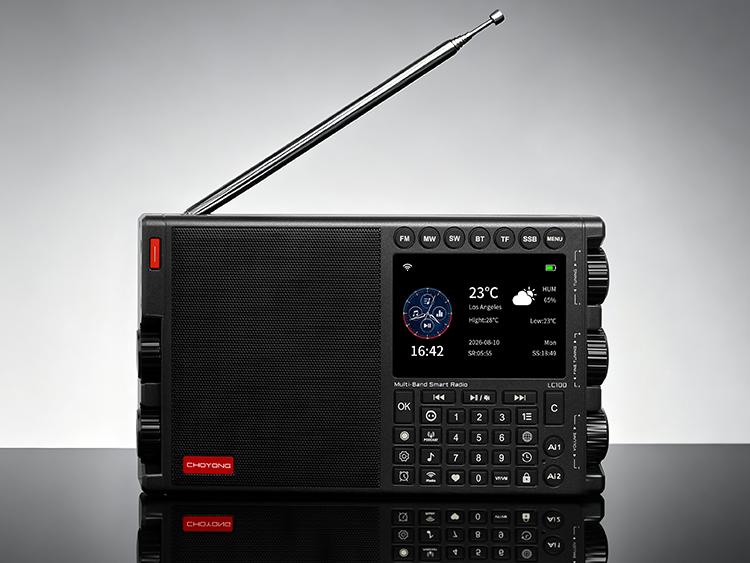
LC100的屏幕上显示着处于待机状态的收音机图标。
作者:约翰·菲利奥齐
在Choyong LC90于2023年推出之前,市场上并没有能够同时提供短波广播和互联网流媒体的收音机设备。即便三年后,Choyong依然是全球唯一的“智能收音机”制造商。现在,他们推出了升级版的型号——LC100。
总结/要点
这款LC100的设计非常出色,配备了多种功能和工具。与LC90类似,它的结构非常坚固,握在手中时感觉很舒适。
LC100这款音响设备所呈现的音质堪称卓越,甚至可以说具有革命性的水平——尤其是对于一款采用塑料外壳的便携式音响设备而言。其三扬声器设计以及厂商在制造过程中对音质的高度重视,使得该音响能够保持出色的音质表现。厂商刻意避免在收音机背面安装任何可能影响音质的配件,这也充分体现了他们在提升音响音质方面的努力。
Wi-Fi网络下的互联网流媒体播放以及调频广播功能表现非常出色,网络连接速度也相当快。同时,流媒体播放过程中不会出现缓冲现象,用户还可以立即访问自己感兴趣的调频电台。
LC100代表了LC90的显著改进。虽然人们在提高AM频谱的信噪比方面付出了大量努力,但这仍然是一个艰巨的挑战。或许正是因为这一挑战的复杂性,才使得其他无线通讯设备制造商至今尚未着手解决这个问题。
不过,将长波、中波、短波以及单边带广播与Wi-Fi互联网流媒体服务以及FM广播整合在一起——同时加入一些前所未有的创新功能——确实是一个非常有趣的项目。LC100对于那些重视广播内容、希望以高品质便携式设备来收听所有广播节目的消费者来说,无疑会非常具有吸引力。
审查方法
Choyong给了我一台LC100型号的无线电设备。我对该设备的性能进行了为期三周的全面测试。
这款LC100与之前的LC90进行了比较。同时,还对比了市场上现有的Sangean ATS-909X2型号设备——Choyong公司声称LC100在性能上明显优于该型号设备,尤其是在短波频段的表现方面。此外,还对比了两款同类产品但已经停产的优质便携式多频段收音机:松下RF-B65和Grundig YB-400。最后,还考虑了一款较为现代但已经停产的Eton Executive Satellit型号设备。
我还关注了在YouTube上由许多购买者和分析师发布的关于LC100的许多有趣且富有信息量的评论。我的观察结果与这些测试和分析的结果完全基于这一个样本得出的结论。我们认为,该样本的性能能够代表Choyong公司出售给消费者的所有LC100设备的性能。
企业背景
深圳朝阳科技有限公司成立于2009年,是一家规模较小的企业,员工人数不超过500人,位于中国广东省的一间普通工厂内。该公司最初为全球知名的耳机和扬声器品牌设计电路板、软件以及音频硬件产品,现在则专注于研发先进的混合式互联网收音机、多频段接收器以及其他网络连接的通信设备。
该品牌于2023年底推出了Choyong Radio这一消费电子和音频工程品牌。据Google Assistant的描述,该品牌的宗旨是“将传统的模拟广播频段(调频、调幅/短波等)与现代蜂窝网络及互联网连接相结合,为便携式收音机设备配备Wi-Fi、4G SIM卡/eSIM支持、蓝牙功能,以及基于人工智能的搜索功能(如集成ChatGPT语音命令)。”
无线电
LC100是一款便携式收音机,尺寸类似于纸质书籍。它由两个可更换的、可充电的18650型锂离子电池供电,总容量可达5000毫安时。通过连接一个5伏2安培的充电线到普通电源插座,可以在大约50小时的使用时间内为电池充电。具体时间会因使用强度、屏幕显示内容以及接收信号情况而有所不同。完全充电通常需要2-3小时,具体时间取决于电池的剩余电量。
这款收音机被包装在一个漂亮的黑色实心保护盒中,盒子的装饰部分采用金色材质,里面包含收音机本身、充电线、一份简短的说明书,以及一个可拆卸的携带环。该收音机有两种颜色可供选择——深灰色和银色。我收到的产品是深灰色的。
根据Choyong的说法,“LC100的目标是简单的:将传统广播的精神与现代互联网音频设备的功能相结合。”该设备结合了模拟和数字技术,旨在进一步改进LC90已有的功能。
LC100能够接收并播放来自互联网、FM、WAV、MP3等多种格式的音频内容。此外,该设备还支持AM广播功能,可以访问播客资源,并且能够录制、存储和播放内容到SIM卡和TF卡中。同时,通过LC100的扬声器,还可以利用蓝牙技术从其他来源播放音频内容。
该平台提供了多种方式来查找和存储互联网上超过50,000个广播电台以及数千种播客内容。用户可以通过ChatGPT进行语音搜索,从而获得快速且准确的回应。Choyong还拥有一个网页页面,用户可以在该页面上创建账户,从而使用或管理平台的各项功能。
最后,在9月15日发布了更新版本为1.1的固件。这个新版本的固件增加了可调式的噪音抑制功能,能够有效减少调音过程中的噪音干扰。此外,用户还可以访问由该公司维护的档案库,其中存储着大量历史广播和录像资料,这些资料可以追溯到一个世纪之前。
Choyong针对LC100平台提出了这些主张:
- 一款高分辨率的3.5英寸彩色显示屏。(LC90型号为2.4英寸。)
- 相比LC90,该设备在FM/低频/中频/短波接收方面有了显著的提升。
- “面向无线电爱好者的高级功能SSB)”,其中包括一种手动操作的频率校准功能SSB)。
- 升级到Wi-Fi 6后,互联网广播的体验变得更加快速且稳定。
- 这款重新设计的音响系统具备低音和高音调节功能。与LC90相比,该系统的低频部分扩展了大约10赫兹,从而呈现出更饱满、更丰富的声音效果。
- 更强大的互联网广播功能与人工智能特性
- 人工智能可以通过ChatGPT语音接口,帮助用户搜索车站信息、播客以及音乐内容。
- 重新设计的待机屏幕显示方式更加直观:可以同时看到时间以模拟和数字形式呈现;当地当前的室外温度、湿度以及天气情况;当天预计的最高/最低温度;日出/日落时间;日期、星期几;电池电量及Wi-Fi信号强度等信息。
我还做了一些额外的标注:
- 通过Wi-Fi连接访问互联网。
- eSIM功能可以作为一种补充方式,提供蜂窝网络与Wi-Fi服务,从而提升家庭Wi-Fi服务的效果。
- AM(左声道、中声道、右声道、SSB)和FM接收方式。
- 设备配备了SIM卡插槽和TF卡插槽,方便录制、存储和播放您喜欢的内容。
- 具备蓝牙接收和播放功能。
- SIM卡和TF卡中的内容(包括音乐和语音文件)可以被读取。
- 分别独立的高音和低音控制功能。
- ChatGPT被整合进来后,就可以通过语音选择来播放流媒体内容以及从互联网上获取的信息了。
- 可调节的背光时间和亮度设置。
- 播客的首选语言设置。
- “自动播放”功能可以恢复至收音机开机时最后选择过的电台。
- 调频频道选择步骤:50、100、200 kHz。
- LW/MW调谐步骤选择(9/10kHz)。
- FM ATS自动调谐系统的灵敏度设置:非常高、高、平衡、低、非常低。
- MW/SW ATS的灵敏度设置(与上述相同)。
- AM消音设置:1-10级。
- USB接口偏移量重新校准。
- LSB偏移值重新校准。
- 温度单位显示选择:摄氏度或华氏度。
- 固件版本信息(在通过Wi-Fi进行升级时提供)。
- 在显示屏上,用户可以通过多功能调谐旋钮来选择不同的选项:
- MW/SW方向上的7种带宽配置(6、4、3、2.5、2、1.8、1kHz)。
- 在SSB上共有6个带宽选项可用(分别为0.5、1、1.2、2.2、3、4 kHz)。
- 在FM模式下,共有6个带宽可供选择,具体为:(56, 107, 158, 209, 260, 311 kHz)或自动模式(由收音机自行选择)。
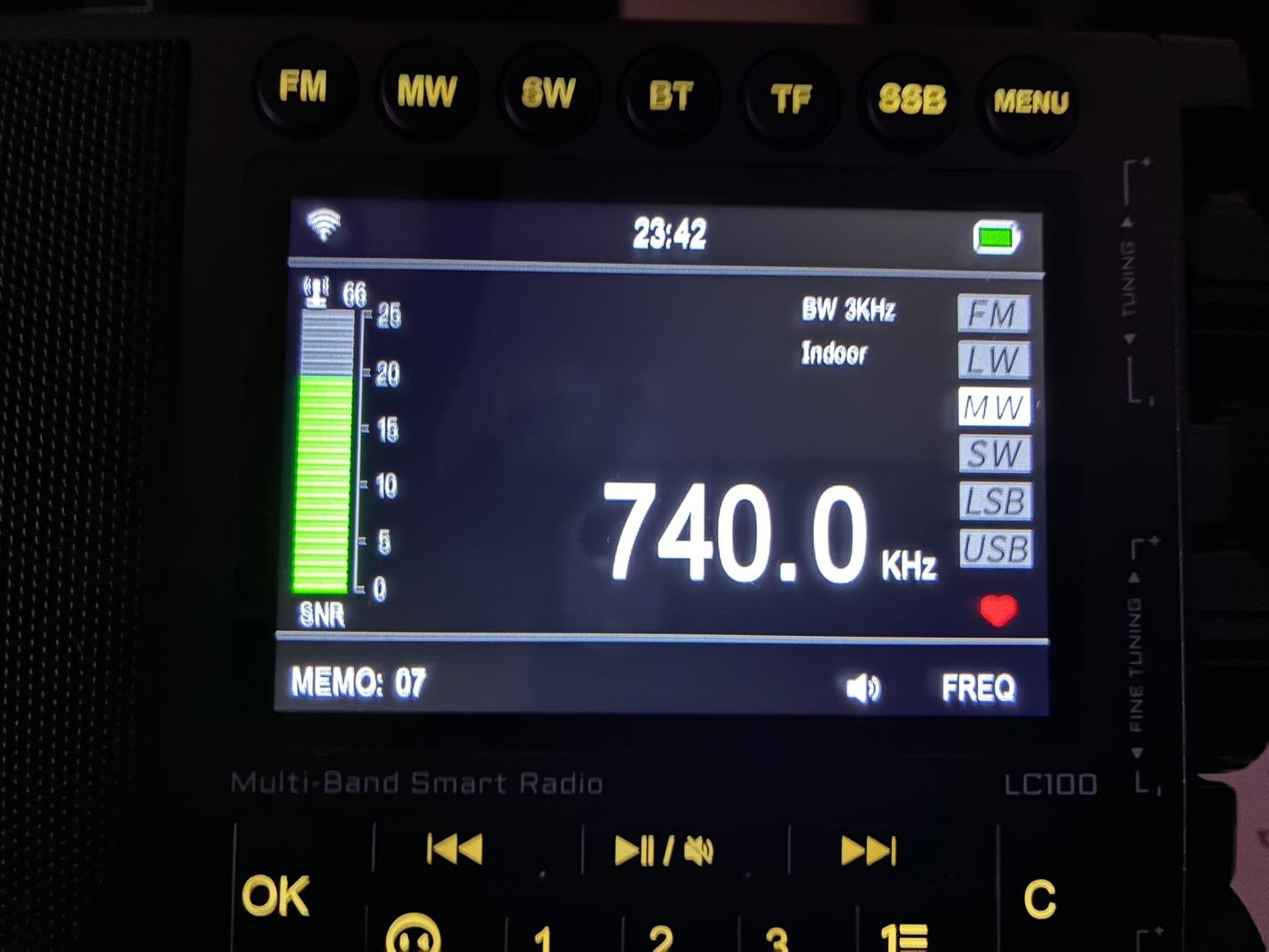
这是当播放MW电台时显示屏的显示效果。左侧的图表中,一个不断波动的绿色条状图标用来表示电台信号的相对信噪比;图表顶部的数字则显示信号强度。此外,屏幕上还会显示Wi-Fi信号强度、当地时间、电池电量、带宽信息、正在使用的天线类型(室内铁氧体天线)、当前模式、电台在内存中的位置以及调谐到的频率。在这种情况下,电台正在收听的是位于多伦多CFZM 740电台,距离我所在位置约300英里远,同时使用了“Select-a-Tenna”设备来提升接收效果。当收音机处于LW、SW或FM模式下时,LC100的显示屏也会呈现类似的外观。
评估
这是一种非常先进、功能多样的工具,它挑战了传统无线电技术的定义和限制。它具有其他任何类似设备所不具备的强大功能——短波、中波、调频、短波、互联网、音乐播放、录音、历史记录查询、基于互联网的信息搜索,以及ChatGPT等智能助手功能。
根据我的使用体验,LC100在性能上确实实现了诸多提升,这些改进完全符合公司所宣称的承诺。此外,LC100还具备一些新的、创新的功能,而这些功能在LC90或其他任何无线电设备中都是不存在的。
它能够快速且安全地找到并连接Wi-Fi路由器。在我测试的样本中,我多次开启LC100设备,始终没有出现任何问题。LC100音响设备拥有出色的音频性能,尤其适合放在塑料包装中作为便携式设备使用。当播放来自调频广播、数字广播(如互联网收音机、蓝牙连接、SIM卡以及TC卡等来源的内容时,其表现尤为出色。
通过互联网广播,下载速度更快,同时可以立即看到电台的“图标”(那些代表电台或网络源的小方块图标)。此外,还提供了多种方式来查找电台、流媒体内容等,包括使用ChatGPT进行语音搜索。一旦选择了某个内容来源——无论是直播还是存档内容——它就会在LC100上播放,且播放效果不会受到任何影响。
其调频部分比LC90具有更高的灵敏度,其内部天线的定向性能也更为出色。这部分得益于天线杆现在位于设备外壳的上方,从而可以实现360度的方向调整。(在我的测试样本中,天线杆被牢牢地固定在相应的位置,如果我用力拉出天线杆的话,可能会损坏它。)显示传输的RDS信息时,信号强度相对较弱。
LC100的AM部分在低波段、中波段以及高波段上的灵敏度也有所提升,与Sangean ATS-909X2相比表现相当不错。不过,松下、索尼和Eton产品的灵敏度则明显更高。尽管如此,正如Choyong所提到的,LC100在AM方面的整体性能都比LC90有所改善。
总的来说,LC100表现相当出色,尤其是在基于数字技术的Wi-Fi互联网流媒体播放和FM广播功能方面。不过,其基于AM技术的其他功能表现则稍显不足。
不过,这种“智能无线电”技术,将数字技术与模拟技术结合在一起,形成一个单一的整体或装置,也带来了一些其他无线电设备所无法应对的挑战。
SNR——AM的关键因素
信噪比(SNR)是决定某个电台是否能被听到的重要因素。每个接收器都有所谓的“噪声底”——即设备内部产生的噪声以及射频频谱中自然存在的环境噪声的总和。要使电台的信号能够被接收器捕捉到,信号强度必须足够强以克服这种噪声;或者相反地,噪声底必须被降到最低程度,这样即使信号较弱也能产生可听见的音频。
调频广播使用的是VHF频段(极高频率),而Wi-Fi则使用UHF频段和SHF频段(超高频率)。由于调频广播对噪声的敏感度较低,并且能够覆盖更广泛的频谱范围,因此它能够提供更高品质的音频信号。
But the AM radio spectrum, where LW, MW, SW and SSB reside, is much more susceptible to QRN and is confined within less spectrum space. Furthermore, our ever-growing roster of digital devices generates an increasingly higher level of environmental QRN that, when combined with QRN already present in the spectrum, confronts AM with a technical challenge to be “heard” that FM and Wi-Fi don’t face. You likely notice this when trying to tune a weaker AM MW station in your car.
额外的信噪比挑战
In introducing the LC90 and now the LC100 into the market, Choyong has set itself a challenge others continue to avoid – combining AM (LW, MW, SW, SSB) with Internet radio, analog with digital technology. The amount of internally generated noise in such a device rises considerably.
Because the LC100 is a “smart” radio packed with Wi-Fi 6, 4G cellular antennas, and a large LCD (liquid crystal) color display, a lot of internal radio frequency interference (RFI) is generated. The LC100 also piles several highly active RFI emitters near its sensitive LW/MW/SW antennas.
Finally, running an operating system capable of handling ChatGPT AI voice processing, managing a 50,000+ station internet directory, and buffering high-definition audio streams requires a fast, power-hungry processor that produces constant digital switching noise.
These present a higher technical hurdle to overcoming QRM and boosting SNR in the radio’s AM section than all other multiband radios face. In a classic portable radio, by contrast, the only real sources of internal noise are the digital display microprocessors and the audio amplifier.
压制群管理功能
This reviewer has no engineering background, but that greater QRM seems to be an inescapable by-product of the necessary electronic architecture of the LC100 despite Choyong’s concerted efforts to provide more and better internal shielding and QRM suppression.
The LC100 does have heavier shielding than its predecessor LC90. It also utilizes a dual-chip design, including the better noise-blanking NXP TEF6686, and has used a firmware upgrade to introduce AM squelch configurations to help clamp down on digital hiss, noise, and chuffing when tuning between frequencies.
Other reviewers have noted that if the screen goes to sleep, noise in the audio drops significantly. My tests of the LC100, however, have not confirmed that because — in my case at least — turning off the display screen and Wi-Fi access have not seemed to have any appreciable effect on the noise level as doing so did with the LC90.
Maybe my experience confirms that Choyong’s noise amelioration efforts have succeeded to some extent.
Still, internally generated QRM appears to be a persistent issue. To the extent it’s embedded in the LC100’s “hardware” – the electronic architecture of the receiver – it’s also probably not significantly addressable through any further software and firmware improvements.
观察结果
There’s no such thing as the perfect radio. This reviewer has owned more than 200 radios over six decades and still retains more than half that number in his current collection. Take my word for it: All do some things better than others. Just as there are “horses for courses” in the sport of thoroughbred racing, diverse listening interests and objectives need to be matched to the radios that are designed to best meet them.
When it comes to LW, MW, SW and SSB, if your primary interest is “DXing” — hunting for incredibly weak, distant stations and signals thousands of miles away — the LC100 likely will disappoint you in that respect. Performance of its AM section, while significantly and noticeably improved over that of the LC90, does not rise on MW or SW to the level of the best in that size and genre – for example, legacy like-sized radios like the Panasonic RF-B65 and the Grundig Yacht Boy 400 that are not challenged with the inclusion of Internet access.
For confirmed DXers, a more traditional radio will have a considerably lower noise floor and, thus, be a more acceptable alternative. Even in that realm, some radios will perform better than others and study will be required to identify and rank them.
There are also some very inexpensive chip-based Chinese-designed and manufactured radios that reviewers claim demonstrate remarkable sensitivity with lower QRM, although with far fewer and less impressive features than the LC100.
The good news for LC100 owners is that this noise hurdle can be overcome to a point that gives usable reception of many MW and SW stations thanks to Choyong’s improvements to the LC100’s sensitivity.
Moving the receiving antenna away from the body of the radio by plugging an indoor active or magnetic loop into its dedicated antenna jack completely bypasses the internal chassis noise, giving cleaner SW reception.
MW reception is easily and dramatically enhanced by using a tuned indoor inductive loop antenna to better orient the LC100’s ferrite bar antenna (display set to “indoor”) broadside to the transmitter location of the desired station, concentrating and increasing the signal level and markedly improving the SNR.
This reviewer’s use of the Select-a-Tenna inductive loop for MW and the Sony AN-LP1 active loop for SW raised the SNR significantly by boosting the desired signal and avoiding or transcending ambient and internally generated QRM.
Utilizing these antennae improved the LC100’s reception of MW and SW stations to more closely approximate that of the Sangean, Panasonic, Grundig, and Eton radios mentioned earlier in this review.
Unfortunately, the loop antennas I used can now only be found on the used market. But currently available loops like the inexpensive AN-200 and MLA-30+ — all well under $50US — fit that same bill.
Doing this, though, somewhat lessens the radio’s portability and marginally increases cost.
Although, as noted, Choyong also improved the LC100’s single sideband (SSB) performance over that of the LC90, there are receivers on the market that specialize in that capability as well. So, if your prime interest in a radio includes its ability to receive and decode SSB signals, you might be wise to look elsewhere.
想法和关切
(1) When using the radio’s “outdoor” mode on MW, the internal ferrite antenna appears to be disconnected or depressed in favor of the telescopic rod antenna. The manufacturer suggests fully extending the latter for best effect.
However, when doing so, this reviewer noted several spurious signals across both the MW and SW bands due to either ingress, harmonics, and/or mixing products within the radio itself, especially when using the radio outdoors. For example, a local station on 590 kHz was also heard on 1570; one on 810 was also heard on 1620. There were several others. Birdies were also noted across the SW spectrum, mostly below 6000 kHz.
Employing “indoor” mode that utilizes the more directional inbuilt ferrite antenna worked better for me, even outdoors, when tuning MW. When indoors, employing “indoor” mode and using a passive MW loop like the Select-a-Tenna always gave noticeably better results than when using the radio’s internal ferrite bar alone or the telescopic rod antenna with the radio in “outside” mode.
(2) The radio’s AGC (automatic gain control) “pumps” when the LC100 is tuned to weak, rapidly fading SW signals. For example, this behavior was noted in upstate NY at 2130 GMT on 11885 kHz tuned to KBS World Radio broadcasting direct from South Korea. The broadcast was made unlistenable. The AGC decay or release time appears to be set at too fast a level. If the manufacturer slows this decay, noise between fades (that “pumping” effect) should subside and the signal become more listenable. The squelch option provided by a recent firmware update cannot adequately address this issue.
(3) As noted, sensitivity has been noticeably improved in the LC100 over that of LC90. However, there seems to be no way to effectively attenuate that sensitivity on MW or SW, although there are apparently such controls within the ATS (automatic tuning system) feature. Nonetheless, using those ATS sensitivity controls and/or varying the length of the telescopic rod antenna seems to have only minimal effect on the amount of ingress or number of harmonics, especially when using the radio outdoors.
In a “good news, bad news” sense, boosting the sensitivity of a radio also tends to increase its susceptibility to overload if strong signals overwhelm the ability of the radio’s electronics to properly process them. If there were a way for the user to attenuate that sensitivity, then there would likely be fewer instances of spurious signals in the radio.
(4) The LC100 provides the listener with some new tools in accessing SSB (single sideband) signals used by amateur radio operators, aeronautical weather stations, and in some other utility transmissions. Tuning steps are reduced to 0.1 kHz, and there’s a way to recalibrate the LC100 to the proper “zero beat” frequency.
The recalibration tools are helpful but inefficient. To perform a recalibration, one must determine and memorize how much recalibration is needed, leave the SSB signal (which goes to silence), enter the settings menu, choose the appropriate (USB or LSB, upper or lower sideband) tool, enter the + or – KHz. of recalibration required, leave the settings menu, and re-enter SSB. In this reviewer’s experience, the radio always returned to USB even when listening in LSB, requiring a further step to LSB and a retuning of the frequency. Learning to use the recalibration tools was a hands-on trial-and-error process since no instructions in a manual or online were offered directly from Choyong.
(5) In reviewing YouTube materials regarding the performance of the LC100, some appear to be having better experiences than others with aspects of the radio. If that is the case, it could be due to a range of ambient reasons or factors present in one situation but not present in another.
But quality control in manufacturing is always of prime concern to any entity attempting to market a product. Eton had two major episodes at separate times with its E1, destroying its marketability even though at its best the latter was a superior product. Is there one here? Only Choyong knows if and how many of its products have been returned by customers for cause.
(6) Choyong has chosen to use a volunteer-maintained database for the 50.000 plus stations and thousands of podcasts it lists in its catalog for users of its products, including the LC90 and LC100. In this way, the Company retains proprietary control over the database and is not dependent on other providers for the continued existence, veracity, or usefulness of that source. Any misgivings over such an approach must be counterbalanced by the fact that several independent contract “amalgamators” have abandoned their efforts over the time Internet radio has existed, leaving purchasers of some radios without any support.
(7) There is a button on the face of the LC100 that is described in the paper “user manual” as an “Internet Radio Button” that claims to link to “local internet radio stations where the device is located”. Although it does provide a listing of about two dozen sources, none of them appear to be locally based. If the idea was to access local radio stations that stream on the Internet, it does not appear to be working as intended.
(8) Some on YouTube have reported that because they use a VPN or Starlink to connect to the Internet, the information on the radio’s display does not pertain to their local conditions as intended. Perhaps a future firmware update can address this issue.
(9) The paper “user manual” provided is rudimentary and incomplete in addressing all that the LC100 can do. Since paper manuals are expensive to produce, tend to get archived, and are rarely, if ever, referenced by product owners, Choyong has suggested that YouTube videos are a better and more efficient way of providing needed user information. They’re probably correct in this assessment, but they need to produce more of them than they have available at present.
(10) At first, I thought the keyboard on the LC100 is not backlit as it is on the LC90. But it is only a much more subtle way to address consumer-expressed concerns that on the LC90 it is too bright and distracting for nightstand use. Toning it down on the LC100 matches the keyboard backlight more precisely to the reason it exists – to allow the user to see the buttons and operate the radio in very low light and dark environments.
(11) With the advent of software- and firmware-based products, they are no longer as “complete” as they once were when made available. Updates and upgrades are easier to accomplish and can defer obsolescence. But it also makes “beta testers” of early adopter product purchasers and can leave an impression of substandard quality control or premature marketing.
Choyong has sought to assuage those concerns by being uniquely open about — and including customers in — its product development processes. If one monitors the comments on its Facebook page serving this purpose, some embrace this opportunity, and some seem put off by it.
Though commendable, it’s also risky. Individual purchasers have preference hierarchies that can differ among customers as well as from Choyong’s intents and priorities for the product. Something one buyer views as important will be seen as nitpicking by another or the company itself and vice versa. The breadth and tenor of some of those comments also bear witness to this fact.
Not meeting a purchaser’s expectations – whether reasonable and objectively on point or not – risks a misunderstanding and disenchantment that eventually gets reflected in those comments. The customer sees only a lack of attention to what they see as their “legitimate” concerns. For its part, the company receives a product assessment that it feels is unfair or off the mark. There can be hurt feelings at both ends. Others may only get confused.
However, having commendably opened the door, Choyong should avoid any urge to close or police it. Rather, the process will benefit from maintaining the dialogue and the company being more direct and specific about its intents and priorities with a product. The mistake lies in trying to be all things to all persons – or at least in a lack of sufficient candor and specificity, leaving buyers with that impression. That is impractical and ultimately self-defeating.
建议
Just as FM uses RDS (Radio Data System) to convey enhanced information like song title and artist, Internet radio sources stream metadata to provide similar text to the listener. As with RDS, not all stations or streamers utilize this tool. But any Internet radio in 2026 worth its salt should have incorporated both by now. Choyong says opening and displaying metadata with its Internet streaming is on its future firmware update list, but it’s been saying that for quite some time. ASAP, eh?
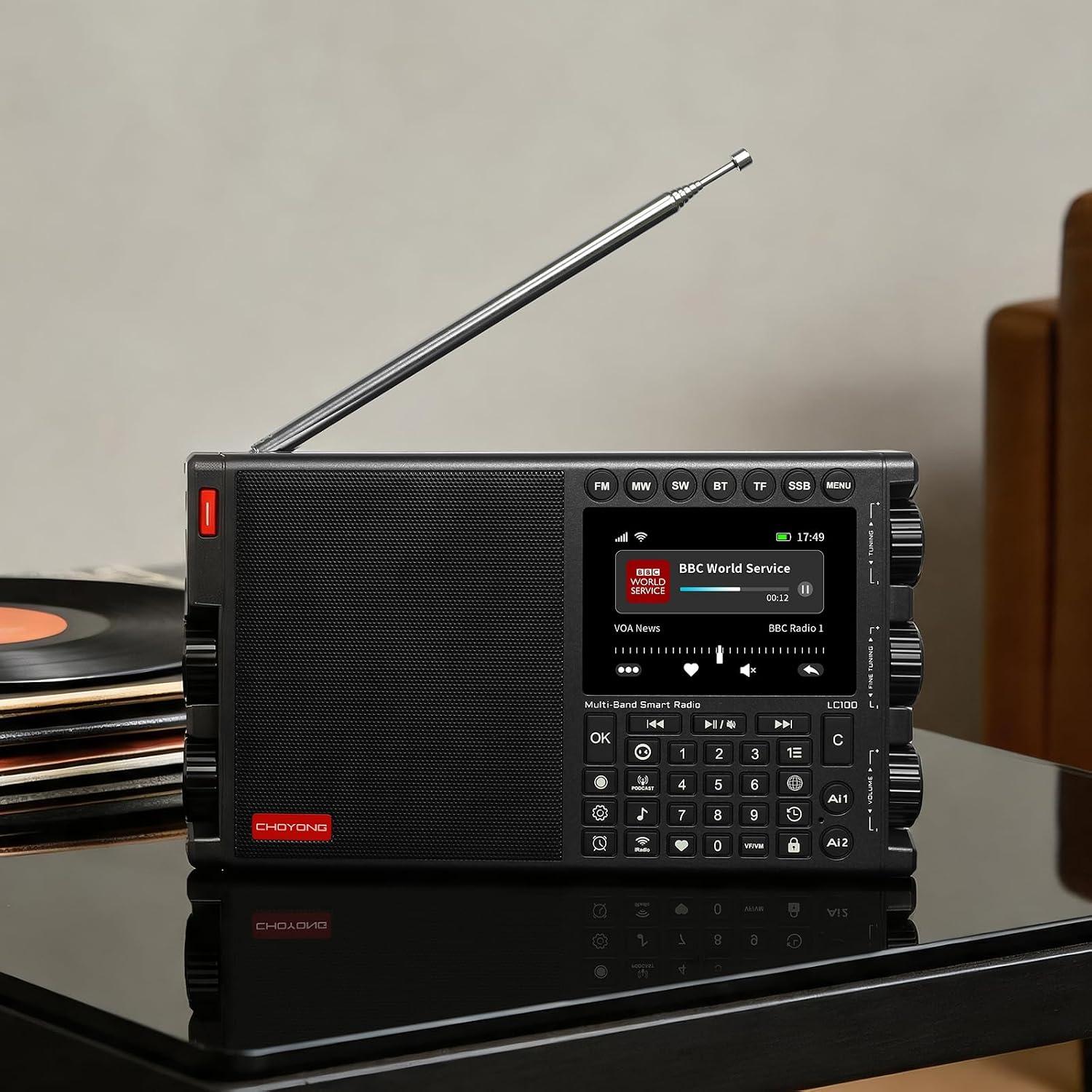
The LC100 screen as it appears when streaming Internet sources. At present only the source name is displayed. Many streaming sources provide “metadata” – simultaneous text transmissions that give the music title and artist and other background information much like RDS does on FM. Choyong has committed to incorporating display of any metadata that sources transmit in its next firmware upgrade.
- Choyong also commits to inclusion of additional streaming protocols as their use proliferates and to expanding existing multilingual support. That is good news as well.
- Choyong’s organization and classification of Internet radio stations and podcasts is better than it was but still needs improved structure and composition. The amount of overlapping, repetition, stream information, and lack of differentiation between similar listings can confuse and exasperate the user.
- In that regard, providing the display of indices that appear on the screens of other Internet radios, like the depth and speed of the stream, size of the buffer, etc., has been suggested. It’s worth considering seriously.
- An ability for the user to label MW and SW frequencies with a station name or call sign would be a worthy enhancement.
- Whether there is indeed a misalignment of the LC100’s AGC should be determined and fixed.
- The company should continue to seek ways and means to reduce QRM challenges to the radio’s AM side.
- Creating some audio equalization settings for different content and styles of music. (talk, rock, jazz, classical, etc.) would represent a user convenience and product enhancement.
结论
Most of the reviews posted to YouTube concentrate on the LC100’s performance on MW, SW, and SSB. Fair enough. But to this reviewer, the LC100 is not principally a shortwave or medium wave focused radio.
Rather, this receiver is intended for those who listen to radio more for its content than valuing it as a hobby. In a sharp departure from all other global radio manufacturers, Choyong remains the only developer of a true “smart radio” that incorporates all reception and streaming modes and promises more.
While Choyong might be attempting to target the widest possible consumer base it can develop for this radio, the LC100 works best as a program listener’s or listener for content radio at home, inside and outside, and on the road.
The “typical” LC100 radio purchaser is looking for the widest possible array of programs, subject matter, information, and entertainment. Overriding preferences for this class of customer will be long-term listenable high-fidelity audio, stable Wi-Fi and the unique availability of e-SIM cellular links that extend Internet radio’s portability beyond its traditional parameters.
Therefore, it’s the LC100’s quicker transitions and responses over the LC90 when choosing Internet streaming content options that are a more important improvement. So, too, with the LC100’s success in producing the highest quality audio response from its speaker section and flawless FM and Internet streaming performance.
Since the audio quality available from Internet radio and FM is markedly superior to that of AM, the availability of LW, MW, SW and SSB capabilities in the same casing, while of lesser import, nonetheless become added value features for recreational use or on the increasingly rarer occasions when Internet access is unavailable or impractical.
For these consumers, improved sensitivity on MW and SW, the better shielding to better protect the LC100’s AM section from internally generated QRM and the advice to employ low-cost external antennae to transcend that QRM will also prove welcome.
To the company’s credit, it has consistently worked to address QRM within the technological confines of the LC90 and LC100. But complaints about issues they consider peripheral to program listening – like a bale to prop up the radio, the lack of a handle, or less than professional SSB performance — will tend to be viewed as of little or lesser import.
There are less expensive — though less “complete” — alternatives that place their emphasis on given valid individual things a radio does or should do. And for those fixed on program listening, there also are several alternative options – FM/Internet streaming radios, smart speakers linked to a tablet or smartphones, as examples A $300 price point is not inconsiderable. But to a customer that felt $250 for an LC90 was reasonable, a $50 increase on a significantly improved and enhanced LC100 probably will feel well worth it.
In the end, judgment of price, value, and utility is always subject to the eye (or in this case, ear) of the beholder.
Me? I believe that, along with written text, radio (or audio or whatever you want to call this medium) is the most literate of them. With video, you are just as likely to get pictures that are incompatible with, or that contradict the central message.
Text and radio, on the other hand, depend entirely on words to convey facts, ideas and opinions. The lack of crosscurrents dampens any confusion.
I like this radio.
I find it right-sized and attractively styled. It’s focused on the kind of listening about which I’m most interested – longer-form content – from every corner of the radio medium but also allows me to dabble in the “play” side of MW, SW and SSB. The need to use external antennae is not personally concerning because SW keeps sending fewer strong signals our way, and distance listening on MW DXing already requires enhanced antennae. I also enjoy and appreciate Choyong’s approach to product development that gives me – the customer – a place in the process.
The LC100, by its very nature, will always be a work in progress. But it’s already the ultimate listener’s radio because it gives the user access to every source of audio content there is in one product. Furthermore, through its introduction of AI and ChatGPT, it is experimenting with making the radio interactive with its user. That’s both an exciting and daunting prospect. One hopes that by including the customer in the product development process, that prospect will turn out to be more exciting than daunting.
But that’s just me. Hopefully this comprehensive – and admittedly lengthy — analysis is helpful to you as you decide.
来源:SWLing Post 短波收听 原文:查看原文 (本文由本站自动翻译整理,版权归原作者及原发布机构所有,仅供学习交流,如涉版权请联系我们删除。)

即可将本文分享给好友或朋友圈